Graus. A city of arches, pointed or rounded, both reflecting the Moorish period, and it is hard to determine which was originally Romanesque, which influence absorbed whom. Find in Graus famous people: find Joaquin Costa, an intellectual who was interested and skilled in so much, and find, we think, or is it legend, El Cid also here, medieval nobleman and military leader.
Graus has preserved its heraldry. Heraldry. Coats of arms. This is the head of a knight above the shield, shield with two zigzag horizontal stripes, curlicues surround. Meaning? Where to find a comprehensive heraldry catalogue for families of the area. This is from house #27, Plaza Major, Graus.
Ancestral houses included the Mur, and the Solanas of the 165th Century. Stonework shows elegant shields. Can we possibly identify any of these? House of Mur. Hose of Solanas. Experts, to your clickings.
Change happens fast now. One day, note the ruin half destroyed between two finely renovated home structures in the main square.
Doorways show great variation.
Who came and went. This shows a scallop shell (apparently) theme above the double door, symbol usually of pilgrims on the Way of St. James, to Santiago de Compostela.
Streets are narrow.
On an opposite side, the theme may be colors rather than architectural difference.
And frescoes -- Casa Pintada.
Some doorways are below the sidewalk level, showing great age.
Passageways and passageways.
1. Joaquin Costa, 1846-1911, was born in Graus, and died here. He was self-educated, and rose from his peasant background to become a distinguished intellectual, a lawyer, a politician, a historian and an economist. He sought social and educational reforms.
We chose Graus because we understood there was a great battle here, the Battle of Graus 1063, and that El Cid saved the day.
El Cid: Rodrigo Diaz de Vivar. The birthplace is also spelled Bivar.
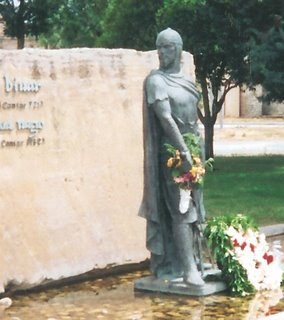 El Cid, Vivar, Spain. Birthplace. He went on to fight at Graus, so they sayl.
We visited Vivar, El Cid's birthplace, during an earlier trip. See his many battles at http://perso.wanadoo.es/ibg3/med/cid.html/ The tourist helper in Graus said that any number of towns claim El Cid, and we found no tribute to him at Graus. Surely here is a gap to be filled. A figure who played both sides from time to time, in an era where that was the way to survive. See Spain Road Ways, Bivar
El Cid. No statue that we could find in Graus, but the stories absolutely must be believed: that he nobly fought here. Then look no further.
Outside the square are other displays, of early production of what? A grinding wheel? A press?
Overview: http://www.spain.info/en/que-quieres/ciudades-pueblos/otros-destinos/graus.html
Graus has preserved its heraldry. Heraldry. Coats of arms. This is the head of a knight above the shield, shield with two zigzag horizontal stripes, curlicues surround. Meaning? Where to find a comprehensive heraldry catalogue for families of the area. This is from house #27, Plaza Major, Graus.
Ancestral houses included the Mur, and the Solanas of the 165th Century. Stonework shows elegant shields. Can we possibly identify any of these? House of Mur. Hose of Solanas. Experts, to your clickings.
 Heraldry, house, Graus, Spain. Plaza Major
At the battle of Graus, 1062, Aragon (under Sancho Ramiro I) lost to the Moors from Zaragoza (under al-Muktadir). El Cid is said to have fought under Sancho, see http://www.heritage-history.com/www/heritage.php?Dir=wars&FileName=wars_castilian.php. Moorish designs remain.
Find the Moor on all sides.
 Moorish arch, Graus, Spain
 Graus, ruins amid renovations. Spain.
Next day, find repair work already beginning.
 Graus, Spain. Reconstructions ongoing.
And what is this bit of heraldry? This heraldry looks like a winged dragon with bird feet above a chivalric helmet, plain shield with five vertical partitions.
 tt
ttDoorways show great variation.
Who came and went. This shows a scallop shell (apparently) theme above the double door, symbol usually of pilgrims on the Way of St. James, to Santiago de Compostela.

Streets are narrow.
 Dan Widing, narrow passageway, Graus, Spain
Enjoy the square. No need to find a hotel that does dinner, because dinners in fine restaurants are everywhere. Here, children were playing soccer in the square, nearly empty because the time to dine is well after sundown.
 Plaza Major, Barrichios, Graus, Spain
Dinner begins at 9PM, and all is quiet in the late afternoon.
 Dodge soccer balls if dining early at Plaza Major, Graus, Spain
Houses on the square are each different.
 Dan Widing at arcades, Plaza Major, Graus, Spain
 Plaza Major, Graus, Spain.
 And frescoes -- Casa Pintada.
 Casa Pintada, Graus, Spain
Some doorways are below the sidewalk level, showing great age.
 Graus, Spain. Inside the door.
Passageways and passageways.
 Passage from Plaza Major, Graus, Spain. Arches.
Is this the same as the square of Coreche, where there is a door of the old enclosure wall, dating from 1569.
Now, find the individuals, some of them, who made this place memorable. And, for a meal early, the famous Graus sausage at a tapas place on the market street beyond the passageway. Longaniza sausage: with its own special day annually -- the endless sausage. Dry, natural cure.
 Joaquin Costa Memorial, Graus, Spain
We chose Graus because we understood there was a great battle here, the Battle of Graus 1063, and that El Cid saved the day.
El Cid: Rodrigo Diaz de Vivar. The birthplace is also spelled Bivar.
 El Cid, Vivar, Spain. Birthplace. He went on to fight at Graus, so they sayl.
We visited Vivar, El Cid's birthplace, during an earlier trip. See his many battles at http://perso.wanadoo.es/ibg3/med/cid.html/ The tourist helper in Graus said that any number of towns claim El Cid, and we found no tribute to him at Graus. Surely here is a gap to be filled. A figure who played both sides from time to time, in an era where that was the way to survive. See Spain Road Ways, Bivar
El Cid. No statue that we could find in Graus, but the stories absolutely must be believed: that he nobly fought here. Then look no further.
Outside the square are other displays, of early production of what? A grinding wheel? A press?
 Graus, Spain. Display of early machinery. For what product? Grinding wheel?
 Graus, Spain. An early press of some kind.
Overview: http://www.spain.info/en/que-quieres/ciudades-pueblos/otros-destinos/graus.html


 Burgos, Cathedral, Spain