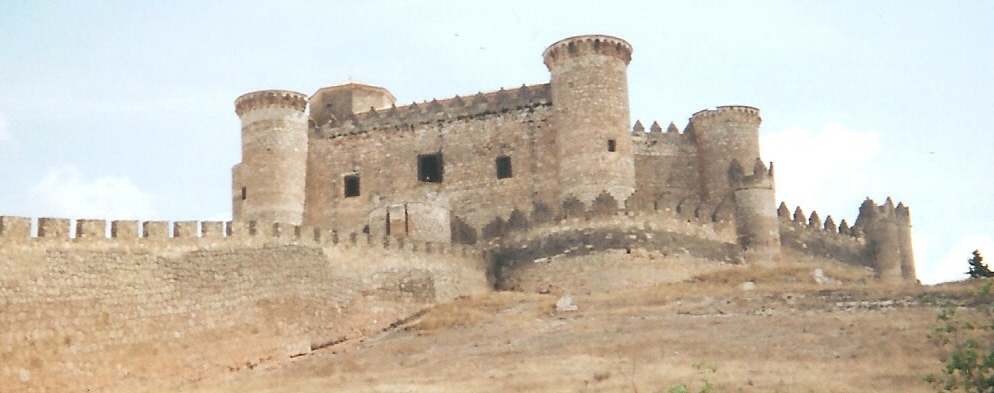
 Castle, Spain, roadside view in passing.
Castles in Spain.
Castle, Spain, roadside view in passing.
Castles in Spain.
Castles are visible all over Spain. Moors occupied Spain from the 800's until the final Reconquest by Spain's royalty and others by 1492. The process of reconquest took centuries, chipping away. The pointed arch-shaped crenellations here look Moorish, but the flat crenellations look like later Crusader work. How to research?
From the visible remains of the Moorish time, in architecture, food, and a flowering of its culture (Jews and Christians could remain, under "dhimmitude" restrictions, but still participating in the culture), take some time to research the religion, the mindsets in conflict. *
Many castles were used as Crusader* castles, even if original structures were Moorish. They were often also repurposed in the Reconquest of Ferdinand and Isabella. See
http://www.historyguide.org/ancient/lecture25b. Some castle were built by one group, then used by successive powers.
This one, identity unknown, resembles Castle La Mota where Queen Juana la Loca was imprisoned. She is buried at the Cathedral at Granada, with her husband, Philip; and with Ferdinand and Isabella. Read the site for a view of life in one of these castles, involuntarily there.
Spain Road Ways, Granada.
...........................................................................
*The Crusader Mindset. Definitive for the Middle Ages.
1. The West was ultimately beaten, soundly, and the Crusades a failure.And the West was trounced. It was the Western equivalent of a Jihad in some ways, except that Jihad is, I believe, a defensive matter. The one who is targeted has to commit an act so egregious, so much a part of a pattern, that the Jihad response is required, part of the submission required to be good. Jihad means to strive, and is part of a process, not engaged in as an isolated or personal matter. Everyman's overview: start at
http://www.answers.com/topic/jihad/
My understanding is that Jihad is, ultimately, the desire to do what is
needed, and that which is seen as an ultimate good, but to do it
defensively - see
http://www.submission.org/muhammed/jihad.html; whereas, the West loves the Offense. Which is worse?As you research, note that you will not find "translations" of the Koran. It cannot be translated. The closest would be the designation of "meaning of the Koran". See
Pickthall's Meaning of the Koran at
http://www.khayma.com/librarians/call2islaam/quran/pickthall/index.html.
2. Find parallels to Jihad, but as an offensive and not defensive matter, in the West: Look for the concept of "evildoers". That idea, that evildoers as defined by the Popes and others, had such non-human characteristics that they could be killed with impunity. It was not a sin. A crusader's sins would be forgiven, if going off to the crusades. Who could resist?
EVILDOERS IN MOTIVATING FOR THE CRUSADES
Religious protection for Crusaders
SAINT BERNARD OF CLAIRVAUX: 1090-1153
"Neither dealing out death nor dying, when for Christ's sake, contains anything criminal but rather merits glorious reward.
"The soldier of Christ kills safely and dies the more safely.
"Not without cause does he bear the sword. He is the instrument of God for the punishment of evildoers and for the defense of the just.
"When he kills evildoers it is not homicide, but malicide, and he is considered Christ's legal executioner."
St. Bernard of Clairvaux thus drummed up enthusiasm for the first Crusade, as quoted at
http://www.the-orb.net/encyclop/religion/monastic/bernard. Do a "find" for "evildoers" and come to the passage where killing an evildoer is not killing a man, so it is ok.
A similar description of the dehumanization of the Muslims. Killing not a sin.
"If he kills an evildoer, he is not a mankiller, but, if I may so put it, a killer of evil.
"He is evidently the avenger of Christ towards evildoers and he is rightly considered a defender of Christians.
"Should he be killed himself, we know that he has not perished, but has come safely into port.
"When he inflicts death it is to Christ's profit, and when he suffers death, it is for his own gain.
"The Christian glories in the death of the pagan, because Christ is glorified; while the death of the Christian gives occasion for the King to show his liberality in the rewarding of his knight."
The past offers a window to the present. Cultural attitudes remain. President Bush favored the terminology "evildoers" -- See
http://www.archives.cnn.com/2001/US/09/16/gen.bush.terrorism/. Do your own search.
 Languedoc's Occitan. Now in Catalan. Montsegur, Pyrenees' last bastion of paratge, 1244 CE, pyres

 Roman Bridge, Cordoba, Spain
 Cathedral, Cordoba, Spain
 Salamanca, Spain, Cathedral facade
 Salamanca, Spain, Shell House
 Castle, Spain, roadside view in passing.