Church of San Miguel, Graus, Spain.
Architectural Clues to History.
Religious site. Romanesque first, then Muslim? Back to Roman Catholic.
Interior of San Miguel. And the Steeple-Minaret.
Religious site. Romanesque first, then Muslim? Back to Roman Catholic.
Interior of San Miguel. And the Steeple-Minaret.
 Church of San Miguel, Graus, Spain. Minaret / Steeple.
 teeple?
The Church of San Miguel in Graus is on a side street, Romanesque in style, easily overlooked. Romanesque. That does not tell us much about its history. Romanesque as an architectural style covers an era ranging from 600-1000 AD. But Moors occupied Spain, beginning 700 in the south, and moving out and around until they were defeated by the Catholic Isabella and Ferdinand in 1492. Moors occupied the Huesca area, Graus included, since the 800's. See http://clio.missouristate.edu/chuchiak/HST%20350--Theme%207-Maps_of_the_muslim_conquest_of_s.htm. Until the Reconquest, that is some 700 years of Muslim rule in the area. What is the earliest date for a construction of a religious structure on this particular site? The history of Spain: Visigoths were the Christians before the Moors, is that so? See http://www.historyworld.net/wrldhis/PlainTextHistories.asp?ParagraphID=ecs
That presents an issue in identifying origins, or repurposing of buildings.
- Repurposed buildings. Moors occupied Spain (700-1492). So, was this building constructed before the Moors arrived in this particular place? Or was it constructed in the older style, after the Moors had prevailed. There are elements of Christian, Jewish, Islam.
- Is it, instead, an early Romanesque structure, repurposed into a Mosque, then repurposed back. Do parts of it predate or coincide with the occupation? For a primer on Romanesque, see http://www.princeton.edu/~achaney/tmve/wiki100k/docs/Romanesque_architecture.html. The steeple part looks more like a minaret than a Romanesque steeple. Did a mosque repurpose an old Romanesque Church, or did the church repurpose a mosque?
1. Could religions really coexist. We don't do well now. Did earlier groups do better?
We know that Christians and Jews could practice their religions under the Caliphate, the Moorish occupation from 700-800 to1492, give or take, with tax and status restrictions, under that Muslim rule. Interesting.
Muslims conquered most of the Iberian peninsula, but did not respond against the locals by forcing them to leave, or forcing them to convert to Islam. Any who did not convert could remain, subject to some but not onerous restrictions, compared to death. The Muslims did not expel Christians or Jews, but incorporated their talents, again with restrictions if they chose to remain. See http://www.bbc.co.uk/religion/religions/islam/history/spain_1.shtml.
- Digression. Who really started persecution against other religions, Christians in Europe, with their heretic persecutions and killings; or Muslim, who offered choices, including remaining and practicing one's own religion, but with taxation and status restrictions. Or leave.
- It was only with Spain's Catholic Ferdinand and Isabella, and the reconquest in 1492, that Christian approved history adopted formal forced expulsion of Jews from Spain, those who would not convert to Catholicism. Nice. Who is more "Christian" - the coexisting Muslims over 600 years; or the Christian persecutors forcing their ways on others. And, confiscating their property. Leave, but with nothing.
2. Dates. So, what is the date of this Church? It has undergone several periods of change. The exterior remains simple and Romanesque, see http://www.spain.info/en/que-quieres/ciudades-pueblos/otros-destinos/graus.html
 Church of San Miguel, Graus, Spain. Baptism. Altar panels, Crucifix.
The altar panels are Gothic, and date from 1450-1500. The crucifix was donated in honor of Graus' patron saint, San Vicente Ferrer, in the year 1415. San Vicente Ferrer: Big festivities bubble and dance up the town, with the town's signature sausage, annually, see September fiesta that we missed. Overviews at http://articulos.altoaragon.org/i_osca87.htm
 San Miguel, Graus, Spain. Mural. Dedication. Details?
3. History shows not in the apse, at the altar area, but in the "cross beam" of the cruciform structure now in place for the shape of the church, and in the lower upright beam of that kind of structure. Rounder churches from earlier days were forcibly recreated to look like crosses after the Roman system prevailed.
Cruciform churches had not been the rule before the rise of Rome's version. In earlier times, there were round churches in Christendom. Mostly. Charlemagne's chapel is round, so are many others. See Egalitarian. The priest equally accessible, all sides, all people. No secrets. The cruciform imposition came with dogma and hierarchy.
Older dates. The more interesting elements of San Miguel are the older traces of times past:
 San Miguel, Romanesque portion remains. But note pointed as well as rounded arches.
  San Migue, Graus, Spain. Pointed arches are also Muslim, or later Gothic. Was this structure originally a mosque? or iwas it, for a time, repurposed Romanesque Christian.
3. Look up, at the apex of converging arches. Whose symbolism visually, if not struturally, anchors the arches?
 San Miguel, Graus, Spain. Apex, Repurposing. Non-Convergence of arches. Is this a representation of a Pilgrim, Way of Saint James?
Keep your eyes off the glitz of the Gothic, there at the Baptism area, and instead focus more on the older areas for roots.Then look up again.
This apex symbol, again where Romanesque-Muslim arches converge, the contact point looks dogmatic; looks Celtic, even Irish. There is a central Crucifix form, then the heraldic-shaped shields, with target in two, shield triangle in one, and cross in another. This looks old, but that assessment would take an expert. What are those symbols?
 Saint Michael, Graus, Spain. Apex of vaulting, Crucifix, then sheild heraldry, enclosed triancle, cross, target circles?
Showing the old history of changes, the arches seen from inside are off-kilter, suggesting repurposing, rebuilding, reconstruction. From what? Which came first? All the changes at The San Miguel Church, cannot all be reconciled. See how the arches here do not meet at the same point. which is before, which is later.
 San Miguel. Graus. Spain. Arches do not converge. Which experts can trace origin?
 First, the Ten Commandments, and then a coat of arms. The Ten Commandments. Both Jewish and Christian. What is the Koran position? No idea. So, was this Jewish-Christian tradition. When was this circular apse on the side constructed? See the Ten Commandments, and then, below, another representation.
 San Miguel, Graus, Spain. Mosaic, large tile, Ten Commandments. And, lower area, a coat of arms
Now: Peer at the shape on top of that lower symbol. Is that the large-brimmed hat worn by pilgrims on the Way of Saint James? If so, we would expect a scallop shell to firm up the identification. Coat of arms is in four quadrants, check the elements.
This is the Coat of Arms of Alonso of Aragon, Archbishop of Zaragoza and Valencia,
and Lieutenant General of Aragon looks like the symbol in San Miguel,
Graus, found at Wikimedia Commons. Tassles, not scales, not bells. Now, what
cross displays the double bar? Recall that in early "Christian"
expansion days, popes and clergy went off to war and killed like anybody
else. See Roncesvalles, Song of Roland (Charlemagne era).
Coat of Arms, Alonzo of Aragon, Archbishop Wikimedia Commons
http://upload.wikimedia.org/wikipedia/commons/b/b9/Coat_of_Arms_of_Archbishop_Alonso_of_Arag
This may be Saint James, scallop shell suspended on the shaft, large brimmed hat. Graus, as other towns in the Province of Huesca, is on the route of the Way of Saint James, all finally converging after Pamplona. The Way itself is many routes. The Spanish consider the Pyrenees to be the real beginning, those arriving from France being preliminaries. On the way: to Santiago as El Camino de Santiago
 San Miguel Church, possible St. James statue, Way of Saint James
What is this coat of arms?
 kk
kk San Miguel, Graus, Spain. Baptismal font? But not Christian symbolism?

 Loarre Castle, near Jaca, Spain. Distance view from flatland side.
 Loarre Castle, Spain, distance view, castle emerging from the cliff rock. Also near Huesca.
  Castellan's Tower, Loarre Castle, Spain
 Castillo de Loarre, Huesca Province, Spain. Monastery complex tower, Augustinian, 1064 or so.
 Interior Courtyard, Loarre Castle, Spain
 A Militant Mary, or something else? La Couvertoirade, Church, France.
 Jaca Cathedral, Jaca, Spain. Night view.
 Pub near Jaca Cathedral, Jaca Spain
 Cathedral at Jaca, side entrance loggia or open room
 qq
qq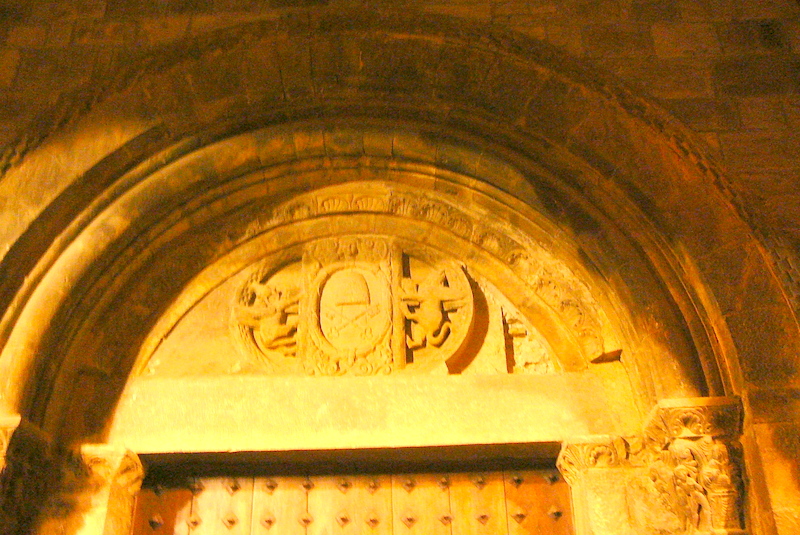 Catedral de San Pedro Apostal, Jaca, Spain. Coat of arms, doorway
 Jaca Cathedral, interior columns showing differing styles
 Small capital, Romanesque, St. Peter the Apostle, Cathedral, Jaca
 Interior, Cathedral at Jaca, Jaca, Spain
 Renaissance renovations, Cathedral at Jaca, Jaca, Spain
 Belfry, Jaca, Spain. Not the Cathedral. What?
 Building contemporary with Cathedral? Wall-spotting, Jaca, Spain.
  Santa Maria, Romanesque. Facade, La Seu d'Urgell, Spain
 Main door, Santa Maria, Seu d'Urguell, Spain. Romanesque.
 Main door, fortified, at Santa Maria, from the inside, See of Urgell, Spain
 Side door, Santa Maria, Seu d'Urgell. Smaller door, but more and fussier columns
 Faces, ordinary people, archway at Santa Maria, Seu d'Urgell, Spain, cathedral
 Door from inside, Seu d'Urgell, Santa Maria Cathedral, reinforcements.
 Interior door to where? Barred. Seu d'Urgell, Santa Maria, Spain.
 Seu d'Urgell, Spain. Interior door system leading to the main fortified door.
 Monastery, down street from Cathedral of Santa Maria, Spain
 Interior door, ornate hinges, Santa Maria Cathedral, Seu d'Urgell, Spain
