Showing posts with label Roncesvalles. Show all posts

Saturday, May 25, 2013

Pilgrim Route. Santiago de Compostela. Camino de Santiago. Way of Saint James

 Camino Frances:  Way of Saint James
Santiago means "James"
Santiago de Compostela
500 miles, Biarritz, France; to Santiago de Compostela, Spain.
Here, near Roncesvalles

1.  Walk to Santiago de Compostela, as a pilgrim on your own terms. Start most anywhere in Europe. Some feel drawn to the grave of Saint James the Apostle.  Is it really there?  The conviction motivated innumerable medieval, and now motivates modern pilgrims, on routes to Santiago de Compostela in Spain, at the far Portugal end.  See beliefs at http://www.timeanddate.com/holidays/spain/santiago-apostle/  Others start the walk for their own reasons, solitary, usually; some small groups.  How to pace each walker?  Easier to go alone?

2.  Routes.  The routes traditionally originate in many countries in Europe, ultimately funneling through France (especially at Avignon as another funnel point)  and the Pyrenees, through passes at St. Sebastian, Saint Jean Pied du Port, to Roncesvalles and Pamplona, or through Huesca, Jaca, Lerida.  See the routes at http://www.santiago-compostela.net/ The most well known may be the route Frances, from Biarritz, France (over the border from San Sebastian)  to Santiago de Compostela, Spain, see http://www.santiago-compostela.net/frances/index_cf_en.html

Pilgrim, Camino de Santiago, Way of Saint James, to Santiago de Compostela from Roncesvalles, Spain

FN 1

3.  Who are the modern pilgrims.  Who takes the long, long walk now?  It is hundreds of miles to Santiago de Compostela from most starting points.  They have their own reasons: self-discovery, self-sorting, as well as religious, for the long, long walk.  Regardless of reason, the routes offer places to stay and wash along the way, and sustenance, and reasonably good signs for where to cross the road -- fast -- to get to the safer other side for a while.  The leg work, however,  is the pilgrim's alone.

4.  Back packs are not necessary.  Use a pull-cart, as in NY from the supermarket. Those who cannot bear the backpack burden can always use the drag-cart.  It does not matter.

Pilgrim, To Santiago de Compostela, Spain, from near Roncesvalles..

Pilgrim with pull-cart. Yes. How you get to Santiago de Compostela does not matter. The motivation to get there, make a change somewhere in your life, self-insight and/or a religious goal, do matter. To whom? Only tothe walker. And that is all that matters. .Take your own time. There are no clocks, only distance, and the feet.

5.  Time commitment. An ordinary person's walk from Pamplona to Santiago to Compostela can take, say six months afoot.  Some divide it into segments, as did a friend of mind, taking three months at a time. I long to go. Do, or can, we just jettison the banal and do it and for reasons important to us but not others?  Need we justify? Do I count?  Does the I in I count, or am I a facilitator for others in this life.  Start walking, kiddo.

These pilgrim photographs are from near Roncesvalles, and some as we move toward Barcelona, crossing other routes coming from the south.

6.  Identifiers.  Pilgrims near St. Jean Pied du Port. On the way, note the Basque traditional structures, the red and white favored scheme. The identification is unique:  a staff, a floppy hat, a scallop shell somewhere.
. cc
And the walker goes on.


Some monument-like sculptures mark the way, an honor seen here, toward Jaca.
.

.From here, some 760 km to Santiago de Compostela.


.The cows don't even look up.

Follow the scallop shell down the sidewalks, down the roadsides, other signs for where to cross over to a safer place where there is a curve in the road.


......................................................................................................................

FN 1

  • Disaster alert.  Will that reference to my own work, to Germany Road Ways, one of our other Europe Road Ways travel blogs, stimulate a random Google to delete my entire blog? Not likely, with one;  but more references, even to oneself, may earn a spam designation and the blog disappears. Is private industry more troublesome to autonomy than government? Private industry can do as it likes with speech, because speech is not protected, not "free" in that setting.

Friday, May 24, 2013

Roncesvalles: Ibaneta Hill, Chapel, Church, Charlemagne, San Salvador, Roland


It is difficult to appreciate the cultural significance of interpretations of the battle here. Read alternate translations, Epic Song of Roland: by Scott Moncrieff or Moncrief at http://www.fordham.edu/halsall/basis/roland-ohag.asp; and a version by Leonard Bacon at http://www.archive.org/stream/songofroland00bacouoft/songofroland00bacouoft_djvu.txt/


The site is comprised of memorials, structures, and a hostel for pilgrims on the Way of Saint James, the Camino de Santiago.


Originally the tale told of Basque outliers seeing an opportunity to assert their rights to their territory as Charlemagne retreated, leaving the cocky younger nephew Roland behind to bring about defeat.  Then the story changed; it became the Moors themselves who became the bad ones defeating Roland.  Culture and religious cohesiveness required that legend, and of those, most important was the need of the Church to create a rallying point.  It appropriated, manufactured a new battle: Saracens by the hordes against impulsive but endearing Roland.

 Epic Poetry, with its need to create larger than life characters and situations to support the might of the power du jour, the militant church and the Holy Roman Empire -- said it was hordes of Saracens who followed them there, won, but Charlemagne Himself returned in time to teach them some lessons, although beloved Roland was dead.

 Cultures:  grab any event, spin it.

What is left on site at the battle area? Who won?  Does it matter.  Again, history says that the attackers were local Basques; but

This place is also, and even primarily, a way-station, resting point for pilgrims on the Way of Saint James, walking to Santiago de Compostela.  Hikers converge through the pass here from many points in Europe, today as in centuries ago.


1. Ibaneta Hill 2. Chapel of the Holy Spirit 3. Chapel of Charlemagne 4. Collegiate Church Ibaneta Hill is the destination point for memorials of the old battle of Roncesvalles -- Charlemagne about 778 AD, his nephew Roland (Other relation? No relation?) who overestimated his own judgment and capabilities and was defeated with the forces he led protecting the rear guard of Charlemagne. Song of Roland:  epic poem, keep an old paperback in the car, and read ongoing every word. How old stories become propaganda vehicles, showing the righteousness in victory or defeat for whoever can pre-empt the basics.

2. Chapel of the Holy Spirit, Silo de Carlemagno, Espirito Santo

This Chapel was built in the 12th Century, tradition says the building was to house bones from the surrounding battlefield areas, Frankish knights.  More likely:  this houses the remains of pilgrims, clergy who died in the area. Still, an ossuary.  Rounded arches, small windows above, Romanesque.  Not the soaring Gothic that the later institutional church developed, to impress, impose.


The interior of Silo de Carlemagno, Chapel of Charlemagne, Chapel of the Holy Spirit

The inside of the Chapel of Charlemagne, is sparse. This is a 12th Century structure, perhaps built on an earlier.  Do a google translate at http://www.lebrelblanco.com/anexos/a0204.htm.  It is said that Charlemagne originated a building on this site to house Roland's remains, see http://www.planetware.com/spain/roncesvalles-e-nav-ronc.htm

Inside the Chapel, there is an ossuary, and legend says that Frankish soldiers killed at the battle in 778 are here. That is doubtful, see http://www.virtualtourist.com/travel/Europe/Spain/Provincia_de_Navarra/Roncesvalles-256059/Things_To_Do-Roncesvalles-TG-C-1.html, but there are many markers lining the walls. From the field? See that the window light was originally through ground stone, alabaster?  The grave markers are lollipop shape, not meant to be disrespectful, but not a familiar grave marking form.  These kinds of grave markers reappear in La Couvertoirade, France, in a Templar village remarkably intact for having been off the usual ways.  Ossuaries in France from WWI look like these in the simplicity, the cavernous spaces, the markers to the side.  See Verdun.


Searches for place names in other languages means multiple identifications:  Here, Capilla de Sancti Spiritus; as well as Silo de Carlomagno.  The Chapel is the oldest edifice at Roncesvalles.


Saint James Chapel, The Santiago Chapel

This smaller Chapel is also from the 12th Century, and holds a statue of Saint James. It is called early Gothic at http://www.virtualtourist.com/travel/Europe/Spain/Provincia_de_Navarra/Roncesvalles-256059/Things_To_Do-Roncesvalles-TG-C-1.html#tip=2277261, but very, very early. No soaring heights, airiness.

One of the routes of The Way of Saint James, the Pilgrimage routes to Santiago de Compostela in Spain (Saint James of Compostela) passes through here. This was built in the 13th Century, and was a parish church.


Then come to the modern chapel, Church of San Salvador.  This replaces an earlier chapel, at the Puerto de Ibaneta, for pilgrims passing through. See http://wisepilgrim.com/alto/puerto-de-ibaneta


With this St. James' Chapel closed, peer through the keyhole.  Click.  This valley is on the Way of St. James, to Santiago de Compostela. 


There have been memorials through the years -- this erected in 1967.


At a distance away is the Gothic Church, the Collegiate Church of Roncesvalles, built by King Sancho VII in the 13th Century as part of a larger complex including a hospital ; and Augustinian Abbey dating from 1130.


Thursday, May 23, 2013

Roncesvalles. The Dead, the Chandelier, the Cross


Roncesvalles has been a site of death as well as inspiration.  Battles against Moors, and Pilgrims on the Way of Saint James, to Santiago de Compostela.  Many died through the years here.  Not all were soldiers.

First, to the pilgrim, and soldier, but what army?  Franks not likely, since the chapel was constructed several years after the battle against the Moors.  Were the markers collected from the field? where?

and other unknowns.


The cross on this marker inside Charlemagne's Chapel, where these kinds of stones are lined up against the walls on and on:  Traditional crucifixion-shape cross, tall vertical bar, short horizontal placed at upper half, but with bent-flaggy shape leaning to the left on top, and a point-dagger below. Figure visible, I think, at base. Keyhole shape for the entirety?

Bannered cross with pointed base.

I do not see that particular configuration at the usual collections of cross sites, see, for example, google's cross shapes at https://www.google.com/search?q=cross+shapes&tbm=isch&tbo=u&source=univ&sa=X&ei=oPkMUpbIDsnk4APfzYAQ&sqi=2&ved=0CCsQsAQ&biw=1366&bih=640

How to report this one?  This chapel is peopled with these markers all along the walls.


Interior, Chapel of Charlemagne, built long after but perhaps on top of, earlier structure. Ossuary.  Round-top, keyhole shape, lollypop, shape -- by whatever description, unusual and meanings need to be researched. For a view of the interior, see http://spainroadways.blogspot.com/2013/05/roncesvalles-ibaneta-hill-chapel-church.html

Another bannered cross, the next in line in the interior wall here:  The first we showed here has a numeral 2 inscribed, and this has the numeral 3.  What are those?


Get an idea of the extent of the battlefield in Charlemagne's defeat at this vantage point.


Charlemagne's chandelier, also seen in Germany at Aachen, and elsewhere.  Collecting those comparisons now.


Wednesday, May 01, 2013

Roncesvalles. Song of Roland. Return to Spain After France.

The Song of Roland - 778 AD -- 
Franks, Charlemagne, Roland: Basques and the Moors
From history to legend to epic.  Make up your own facts. 

Translator of epic poem glorifying Roland and Charlemagne,
despite victory of challenger Saracens
 Dorothy Sayers 1957

Real victors:  small band of Basques

Death by Sword
Roncesvalles, Navarre, Spain

Our road trip left Spain at La Seu D'Urgell, and roamed in France: Cathar country at Rennes-le-Chateau, Languedoc, Camargues, and Provence (see France Road Ways. Then we returned to Spain from Pau, and Saint-Jean-Pied-a-Port; and to Roncesvalles, in the Basque country. Our trips cross borders freely.

Roncesvalles is a valley region, a large elongated ravine plus flats, that is one of the major passes in the Pyrenees between France and Spain. The issue addressed by the region is this:  How does history pass into legend, and legend pass into epic. Is it possible to re-gather earliest sources and track the process, and come up again, or for the first time, with "history."


Roncesvalles is the area, and a village nearby where, according to the epic Song of Roland, Charlemagne's army went into dignified retreat, having set its sights back in France.  Charlemagne left with a rear guard vastly unprepared for its task of protection against attack from behind.  The brash Roland (nephew, other relative of Charlemagne?) insisted on taking a stand against the Moors and virtually all of Roland's forces were slaughtered by the Moors.  The odds were known to be overwhelming, with scouting reasonably accurate, and the Moors were already well entrenched in Spain, with easy supply lines.  Epic poems do their best to valorize Roland, but even  Dorothy Sayers' translation shows the ongoing conflicts, agendas, personality flaws, failure to plan, that led to the disaster.


The setting:

Back to history.  Charlemagne had been battling the Saxons, northern Germanic area tribes, see Sachsenhain, for  for decades. The goal was to reestablish an Empire, like the Roman had been, but now with the forcible Christian slant of the Holy Roman Empire. We may like to think that Christianity prevailed over most of Europe thanks to merit and morality; the facts lead to another conclusion.  Forced conversions on pain of death, slaughters to follow up on recalcitrance, and militant Popes and their minions wielding sword and shield in the name of Jesus.

While he was so engaged, the Moors were battling among themselves in Spain, having taken over most of it and now at odds with each other.  A deputation of Moslem princes asked Charlemagne for assistance in fighting off other Moslems.  At the time, the Moors were no particular threat to the rest of Europe.  Hoping to get Moslem allies for his own Holy Roman Empire expansion, Charlemagne put his Saxon efforts on hold and rode with his army south. He divided his army so one entered Spain near Girona, and the other near Pamplona. Charlemagne's forces defeated both Girona and Pamplona on behalf of the allied friendly-to-Charlemagne Moslems.  That left the enemy Moslems in Zaragoza, however.  Meanwhile, the Saxons reasserted their desire for independence from this violent militant Christian business back in Germany, so Charlemagne declared victory and retreated to cope with Saxons.


  • Another version, older, has the battle at Roncesvalles not with hordes of Moors, but bands of local Basques -- not many -- and a band of Charlemagne followers -- also not many.


History becomes legend becomes epic; where the bits of truth, where the fabrication. Just be aware.

Charlemagne left who to protect the rear?  The legend-epic says he left his nephew, or was it another relative or perhaps not a relative at all, to guard the retreat.  Roland, we are told.


The stories diverge, however.  How to date what?  History.  Earliest versions recount that it was not the Moors who were the dastardly attackers, but the Basques, a local ethnic tribal group with no love for either these Christian warriors or Moslem.

And these Basque upstarts attacked Charlemagne's representatives, who were named Eggihardt and Anselm, and their inadequate force.

Then the story disappears for some centuries; and re-emerges thoroughly legendized and spun. A little bit of history became larger than life. And the snippy Basques in the tales morphed into a new identity -- Saracens, now, and their army now numbered in the thousands.

The introduction to the Song of Roland gives details of the changes in plot and character.  Instead of Eggihardt and Anselm, we have Roland Himself. By the close of the 11th Century, the story is firmly fixed in Roland's court.  And the agenda is clearly religious by that era as well.

The Song of Roland reads as though the hearers are already well convinced of the facts, all is familiar, and they want the bonding of re-hearing and re-vitalizing nationalist or religious fervors.  But memorials keep alive what appears to be the closer story, Basques as victors, not Saracens at that particular battle area.


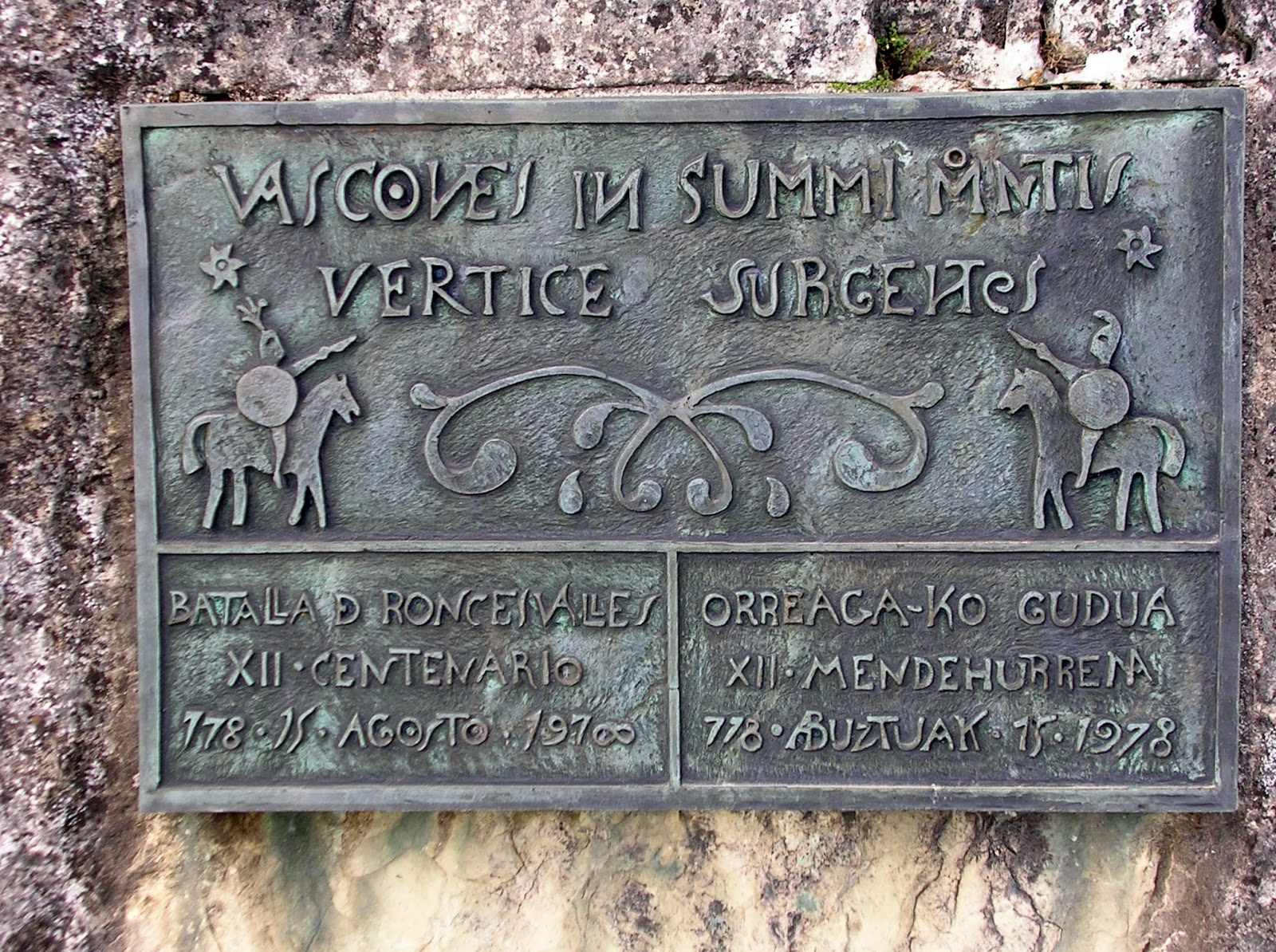
This occasion in 1978 memorializes the adversaries as Basque the victors, and Charlemagne the loser. See http://www.euskomedia.org/PDFAnlt/lankidetzan/20/20221233.pdf

Tuesday, February 12, 2008

Pamplona - Getting Older; and History

Festival of St. Fermin - Bull Running Agenda

For the July bull-running festival, there are parades during the day for the - large puppets over head. If you arrive in the middle of one, however, expecting to see macho, athletic young men flexing all over the place, think again.
Pamplona, Parade, Spain
.
This has become family reunion time. All the strollers and spouses. There are plenty of young people, sleeping in the park like old Woodstock or something, and the partying goes on all night. Still, the impression is of middle aged people coming back to relive what they did or wished they did, or made up that they did, this time with the kids. All is red and white. For all ages and shapes. No place to go, so just turn off the ignition and let the parades flow around you. Get out and join in.

History: Plenty to do after the run. Pamplona was a Roman town 75 BC - near the Basque area and town of Iruna. It does not subdue - as the Visigoths and Moors found. Even Charlemagne and his Franks were stopped by the Basques at Roncesvalles nearby. In medieval times, there were three towns at that basic spot, with differing populations - Basque, French (see how close to the Pyrenees) and a mix of others. The French tried to take it definitively in 1521, lost, and Ignatius Loyola - who fought there - was wounded and later founded the Jesuits. For a long time, Pamplona was frontier. Walls, fort.

Listen. The Song of Roland at ://omacl.org/Roland/. Here is an online translation of this old French poem, about the son of Charlemagne and his death at Roncesvalles. At ://www.fordham.edu/halsall/basis/roland-ohag.html.