Thursday, October 31, 2013

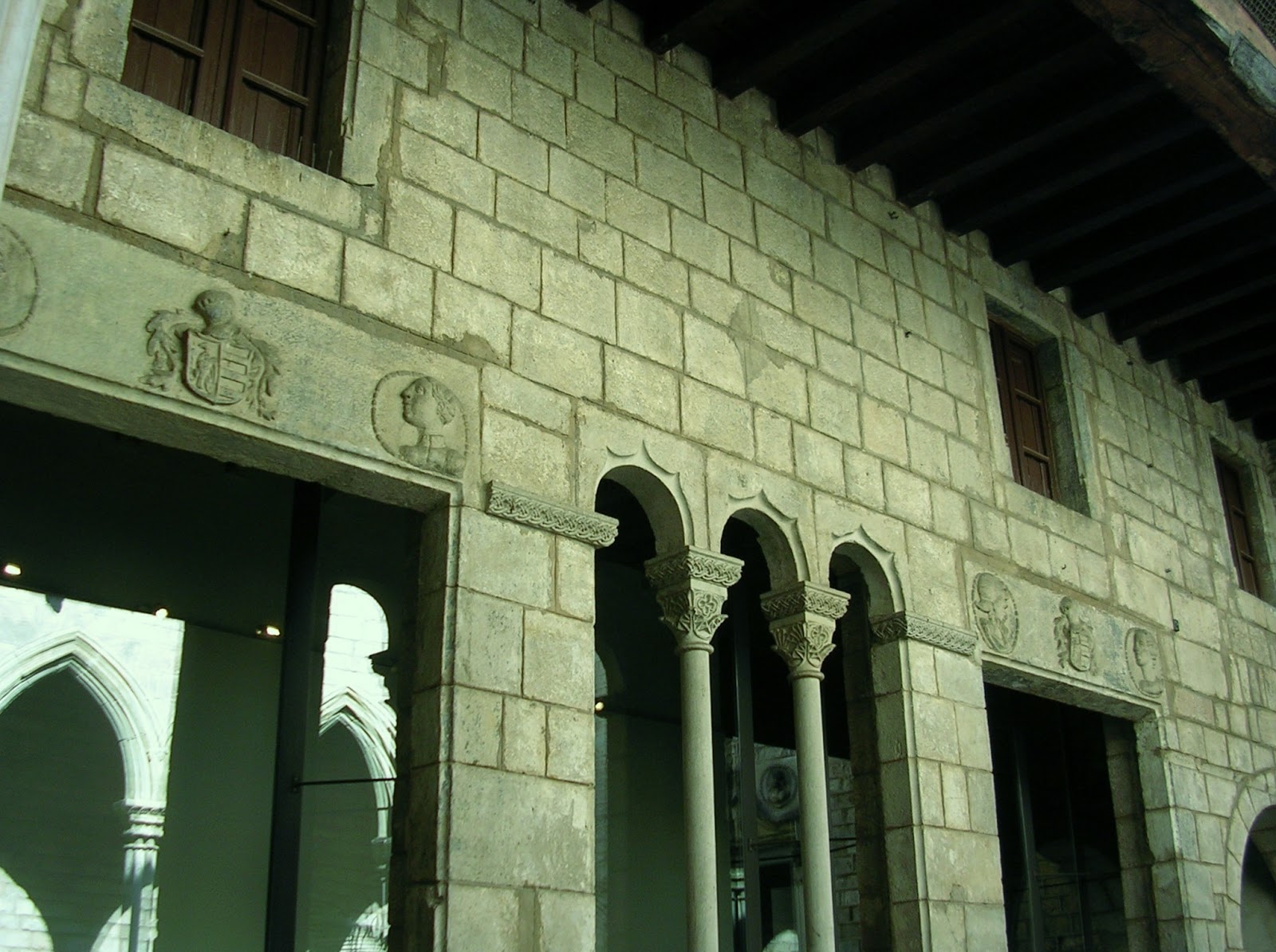
Barcelona: Palau Menor. Mystery M on Templar Doors. Cathar-Templar, or Mere Decoration? Royal Palace Minor

M's on the Doors
Palacio Real Menor (spellings vary: Palacio Reial Menor, Palau Real Menor)

Palacio Real Menor, Barcelona. M's on Doors.

A. Background. Keep the palaces straight.

1. There is the Palacio Real Mayor (Palacio Reial Mayor)(Major Palau), and the Palacio Real Menor, a royal chapel nearby. The Palace Major is in the Gothic quarter, and was the residence of the Counts of Barcelona and later, for kings of Aragon. It has been documented since 1116.

2. As to the Palacio Real (Reiale) Menor, construction also began early, as a Templar project in 1134 or so. Upon dissolution of the Templars in about 1213, the Knights of St. John Hospital (Hospitallers) were granted rights and properties formerly Templar. The Palacio Real changed hands, and then was rebuilt after much wear and tear. The Requesens family took over. Wikipedia's Encyclopedia offers a good non-touristy framework for understanding its history. The original structure, however, was demolished in the mid-19th Century.

3.  Is anything original left inside or outside, even if refurbished. Are some items or symbols used from storage somewhere, from the 19th Century. Who knows. It takes a Spanish speaker to sort out the sites. Explore. Specifically:

B.  What are the M's on the doors to the chapel here:  the Mystery M on the chapel doors.

1.  I see no royal or other prominent person with the M initial, who would likely be memorialized there. 

2.  There is this opportunity for logical conjecture.  M's on the march"

Juxtapose this set of Mystery M's with Egyptian references, perhaps; with the mystery of the name of the North Gate at the Templar town of La Couvertoirade in France:  The Gate of Amoun.

That seems to be a reference to Amun, or Amen, an Egyptian theological concept.  Perhaps the Amun, or Amoun Gate represents some connection to the Templars in crusades in Egypt, such as the 7th Crusade; and what did they learn there, or bring away, or what did they learn while under the Temple Mount in Jerusalem that led them ultimately to track matters back to Egypt.

Ma'at -- goddess of the order of things, a part of (perhaps) theologies morphing through the Paulicians to the Manicheans, to the Bogomils to the Cathars, and Templar access to those things. See http://www.cathar.info/120117_heavenhell.htm   Rebirth, transmigration of souls, origins of heaven and hell notions as not particularly or uniquely Christian after all, despite Michael, and where was Jesus for the first decades of his adult life if not Egypt?  Or Memphis, a particular theological setting in ancient Egypt, the Theology of Memphis, see http://www.csun.edu/~rlc31920/documents/History%20110/Theology_of_Memphis.pdf, including the power of annunciation, the Word that, when spoken, creates the reality of which it spoke, the idea creation out of nothing else, etc. 

Or for Mother Mari, see http://www.bibliotecapleyades.net/esp_autor_whenry04.htm;
or the manuscript "Mari", same site.

C.  Tradition has long held, variously, that Templars did bring information or documents or something that the Church would want to control or suppress or use for itself as to earliest Christian beliefs and where they originated.

1.  Why not look more seiously at ancient Egyptology, Egyptian religion, perhaps connecting to Amun, or Amoun, and see what would disturb the militant, territorial and hierarchy-driven Christian church as it separated itself from the rest of Christendom in the 11th Century.

2.  Theology of Memphis.  This is one of the several evolving theologies of ancient Egypt, and the one that matches the M's.  What would be found there of interest?

Many ideas.  The creative power of the Word, anticipating the Logos doctrine of the New Testament, and Creation stories where the power of the utterance leads to creation itself, out of nothing but the idea spoken, the similarities to what we have been told are Israelite concepts in conjunction with a God that chose then dabbled with them and their fates, and the Creation stories included in the Western Bible.

Where to start?  Start with the actual theology of Memphis, at http://www.csun.edu/~rlc31920/documents/History%20110/Theology_of_Memphis.pdf.  There, on the chart of the gods, see Ptah, the god of craftsmen among other things.  Templars, Templar symbols and ritual, Masons, a possible connect. 

Then see, after Ptah, Atum. Sounds like Adm, Adam. The concept of what the created thing included.
And, step 3, take a short cut again to Wikipedia Encyclopedia for a summary of the various Egyptian approaches, at http://en.wikipedia.org/wiki/Ancient_Egyptian_creation_myths 

This suggests that the Templars espoused or at least opened the door to the Memphis Rite.  So, what are the M's on the entry doors of this last vestige of an old Palace, a royal palace once, now merely minor. There  is a larger, more prominent palace that remains elsewhere, but nearby.

The chapel that remains of the minor palace here is deep in alleyways, perhaps was moved to this place when the city walls were torn down so the city could expand.  It is hid amid narrow streets where you can almost touch the walls of buildings on both sides, where even the GPS laughs at your going in circles. We still felt safe.  Go where you like when you travel.

3.  Double M. 

We know this chapel has Templar connections. In 2013, we now also know that the Templars were absolved of heresy even in the decade in which they were tortured and killed on that ground, and their property confiscated (where, ask the legends, is the real treasure?) and divided between the King of France, Philip the Fair, Philip II.

Absolved?  Yet, the Roman Catholic Church, under old Pope Clement V, hid the story and is the Vatican only now about to release a book about all this?  The Chinon parchments from the old trials? See http://www.telegraph.co.uk/news/worldnews/1565252/Vatican-paper-set-to-clear-Knights-Templar.html

  • Rather than pass off the idea of ancient Egyptian origins of beliefs that Western Religion likes to think are uniquely Christian, read Ancient Egypt, ed. David P. Silverman, NY Oxford Univ Press 1997 at 125 ff. Amun the Unknowable, the Memphis theology, the Word of God, Akhenaten, time and eternity, etc.  
  • The institutional church's violent killing and discrediting of Manicheans, Paulicians, others, and the centuries of book burnings and destruction of ancient libraries: ask, what does the Vatican Library, for example, still hold, that may cast real doubt on the "Christian" obsessions with hierarchies and rules that prevent autonomy, discussion.
 
Meanwhile,the M's.  Hobnail pattern.  Is the door wooden or leather. I cannot recall and my notes are silent.  If leather, would they be as old, or would the leather have disintetrated. 

D.  More possibilities for the M, for other researchers and amateurs to investigate in order to ward off Alzheimers:

1.  M is for a Masonic M. Not yet.

Not so far.  I see no Masonic M in an overt M pattern, only the M in some hand signals, ring and center finger together, pinky and pointer separated.  Is that so?  A dead end for us. We know that later Freemasons built their rituals and whatever on allegedly Templar roots, but this particular clear alphabetical, not particularly occult, capital M eludes me.

2. M is for Mary, Virgin Mary. Not yet. But see the reference to Mari, above.

Not so far.  I see no other name for this place so far than the chapel of the palace minor, that the Templars allegedly used.  This one: There are statues, carvings, paintings of the Virgin Mary inside, but not reflected in the name. There already is the Barcelona Cathedral, the Saint Mary of the Sea, the Santa Maria del Mar.

From the nature of the portraits, alcoves with apparent Madonnas, echoes of  Black Madonnas not entirely explained by mere exposure to dampness, must, fire, whatever, emerge.  Some black figures whether of Jesus of Mary appear to be intentionally black. How to cross reference all we have found in 15 years of European travel on our own, without Google's algorithm accusing us of cross-spamming ourselves and deleting the whole thing.  Pity.

3.  M is for a more occult form of heresy, shown here, if the M means that, to have survived the decimation of the Templars who were charged with heresies on other grounds.

Back to the Memphis Rite. 

The Memphis Rite, ancient Egyptology, where the very origins of the nature of the creating deity, long claimed to be the purview of the Israelites as Chosen - and ultimately the group that claims to be the only legitimate inheritor of Christ's true whatever.


Wednesday, October 02, 2013

Barcelona, Royal Chapel Minor, Interior. Santa Maria de Palau, 4 Ataulf Street. Four Atulf Street. Templar Origins

Interior, Chapel, Palau Reial Menor 
Royal Chapel Minor, Barcelona 
Santa Maria de Palau
Lesser Royal Palace

Once Templar

Arrive at 4 Ataulf Street after dusk, after a long site hunt through alleyways, enter to find a small service in process, wait and feel welcomed. A very old priest, perhaps five worshippers, all old, old.  Polite photographs, each time gesturing for permission as the equivalent of the altar guild closed up.


Barcelona, Altar, Interior, Chapel, Palau Reial Menor, Royal Chapel Minor,  at 4 Ataulf Street. The Lesser Royal Palace.

This Chapel was once a Templar place of worship, although it has undergone renovations, and even been moved to this location.  What is original?  I am still looking for a comprehensive assessment somewhere.

Templars being exonerated. The Templars were declared heretic in 1307, tortured and killed, and the Order dissolved in 1313.  I understand that the Vatican is in process of exonerating them, update October 5, as Pope Clement found them innocent of heresy long ago -- and suppressed the order.  It has been found, misfiled.  See a history by an ongoing group, http://www.templarusa.org/who.html

1.  On the walls were several Cross Alisee Patee shapes, Cross forms, like a engraved stencil perhaps, re-darkened, but not deeply carved into the stone.  FN 1.

Templars held no monopoly on crosses like these.  See variations of this rounded, encircled variation also known as cross formee or cross formy, but these shapes frequent their places.  Do a search, in images.  A motorcycle club has adopted it for its protective symbolism, see http://www.protectorsmc.com/Colors.aspx/.  


Crosses Alisee Pattee:

.
More crosses alisee pattee at the Santa Maria de Palau.  This niche is stoned up.  Would that make the cross affixed more likely to be original, but where does the door go?
The chapel itself was moved to this location after 1859 when the rest of the palace had been demolished or was crumbled, see the long history of this chapel and the Templar history at http://catholicbarcelona.com/2009/11/04/santa-maria-de-palau/ 

2.  Chapel history, roughly:

1099          Bernard of Clairvaux establishes the Templars, see chronology at http://www.middle-ages.org.uk/knights-templar-timeline.htm/ Crusades continue.
1134         Templars establish a "garrison-fief" along the city wall, to continue and enhance their influence over Aragon, capital Barcelona. A larger church was built outside the city, at Palau -Solita. See http://www.monestirs.cat/monst/bcn/cbn02pala.htm (click to translate)
1246-48   Chapel built by Templars
1282         Templar commanderie moved from Palau-Solita to this location
1312         Catholic Church and King decimate, killed most of the Templars, in a hunt that went on for years, and confiscated their property for their own coffers
1354-57
to 1400     While a convent was being constructed for Dominican Sisters, the Chapel here was given over for their use. Entrenchment, conversion, of the institution's ideas and policy to further weaken Templar influence, even in memory.
 1500's -
1850's or so  The powerful Recasens family take control 
1542        Recasens family builds larger tower and Gothic vaulting, stonework
1859        Old palace torn down, as part of tearing down old walls, expanding the city.  Area given over to Jesuits, chapel renamed Our Lady of Victory.  Jesuits tore down the tower and added a second story for their library.
2001 +/-  Restorations.  Mass once a day.

3.  Number 4 Ataulf Street, Atulf Street, Barcelona.  At the time of the renovation in the 1600's or so, how much of the original chapel,although later moved, was left even then? These numbers could be part of the stations of the cross, and not the building address number for the post office, is that so?

Interior, 4 Ataulf Street, Chapel, Palau Reial Menor, Barcelona

Station Number 4 would be where Jesus meets his mother on the way to the cross.  To be checked. Need to enlarge, etc.

4.  The Black Madonna, the Virgin of Montserrat. Niche at Royal Chapel Minor


Why is.The Black Madonna of Montserrat here?  The original is a centerpiece of a monastery some 30 miles to the northwest, and is reproduced in many places. Pope Leo in the late nineteenth century declared this carved Black Virgin to be the patron saint of Catalonia. Does the original date from the early Church in the Holy Land, even carved by Luke, or is it merely Romanesque from the 12th Century?

Scholars disagree, see http://campus.udayton.edu/mary/meditations/olmont.html

Somebody could take a chip and date this, but apparently it has not been done. Still, why would it appear in a Templar chapel, renovated in the 16th Century, except that later believers apart from any Templar roots wanted it?

This stone niche is more approachable than this fenced-in Black Madonna. Same church?  Coloring and gilt are all different, so I have to check.  Meanwhile, no label. My son and I swapped cards as my more "advanced" camera finked out, and his soldiered on.


5.  Ironwork, interior door, Palau Reial Menor.

Again, I believe this ironwork door was from the interior of Palau Reial Menor, but the swapping of photocards makes it uneasy.

I was interested because of a similar door -- would you believe -- in a Templar round church in Denmark. See it at http://denmarkroadways.blogspot.com/2011/07/bjernede-inside-round-church-rundkirke.html/. Now, look specifically at the lock forms.  A variation on the usual crosses.  Still checking that.


5.  Place-holder photograph while I check.  These have no embedded identification until I find more definitively what they are. Those of us who travel on our own, with cameras, and sloppy notebooks,  make mistakes, but want to preserve a record for later correction-additions.

Bear with us, and do try this kind of travel, on your own.  Adrenalin, brain synapses and fun,  can result from these kinds of hunts. for some of us.

Questions from our poor record-keeping in our sloppy but well-meaning logs:

Is this from this church, or another?  Here for now, unlabelled until sure.  There is a 1748 in it, and reference to ____ de Ramon. Earlier Ramon connections could be to the Counts of Barcelona, see http://fmg.ac/Projects/MedLands/CATALAN%20NOBILITY.htm/.  But this one?


Also here as a placeholder. Which church? With fiddling, perhaps I can type this one out and translate.


Also not sure.  Looks too fancy for here. Dan and I had to swap cards sometimes when my untrusty camera died on and off.

Closeup of black madonna from photograph of whoever above.


Symbol of the crescent, connected with Black Madonna; or perhaps another figure, Sara la Kali,.  See Gdansk at another site of ours, at http://polandroadways.blogspot.com/2007/09/gdansk-church-of-saint-mary-black.html/  Tracking groups' dogma and narrative is one thing, and usually leads to ambiguities that do not fit.  Go there yourself, pose the question, and see what else you find. 

Follow along:  now go back to Denmark's Rundkirke, and find the crescent also on the headgear of Saint Lawrence, at http://denmarkroadways.blogspot.com/2011/07/bjernede-inside-round-church-rundkirke.html

Do those anomalies, coincidences, repeated theme symbols, add up to anything?  We stay interested, and surprised at the lack of first hand information we find.  Everyone seems to quote from other sources and conclude that those, because antecedent, must be correct.  Nuts.

6.  Skull and crossbones. 

Hold this image.

This church or another?  The symbolism is explored, vet it yourself, at http://www.bibliotecapleyades.net/sociopolitica/sociopol_masonsknightstemplar06.htm

It is hard to imagine that this would survive not only 1312's slaughter and confiscations, but also possession by the Catholic Church and the rest of the history here.  Did it?


7.  Heraldry on the wall, high up, Ssanta Maria de Palau 

.


In close-up, there are four quadranats, with a diagonal going from high left to lower right, facing the sigil. In the top right quadrant are four it looks like horses, a checkered sheild is in the center, and two animals (also horses or are the necks too short?) in the lower left quadrant.

There is a heraldry institute of Rome. I looked up the Recasens family, but came up dry, at http://heraldrysinstitute.com/cognomi_italiani.php?paese=Spain&lang=en&cognome=Recasens/ This shows Recasens, but no similarities with this simple quadrant and diagonal cum horses. See http://www.heraldicapellido.com/r2/Recasens.htm


8.  Stonework by interior door, renovations-repairs apparent.  Need to do a close-up. And what is the M?


Close-up of other portal work, see http://www.monestirs.cat/monst/bcn/cbn02pala.htm


..................................................................................................

FN 1
  • Missing from this otherwise fine site for interest-routes available to tourists in Spain is anything to do with the Templars.  Are the guilty institutions still so fearful of them, while the rest of us remain horrified at the bloody revenge taken upon them beginning 1312 for their acquisition of power and development of whatever they developed, on their own? See http://www.plustravelspain.com/routes2.html/ Templars.  Denied even the memory, the fate of those deemed heretic and whose property was confiscated to enrich the powers; and is that why the fictions grow? 
  •  Needed:  A route that will root in Templar fact, if any can still be found after the destruction.
  • Shall we examine exactly what was heretical about them, and why differing beliefs should justify mass murder, as it does and did?  The heritage of crusade:  that those who deem themselves right can kill of the others, and do so without societal consequence.

Tuesday, September 24, 2013

Barcelona. Chapel of Palau Reial Menor. Early Maltese Cross: The Alisee Pattee. Royal Palace Minor

Chapel of Palau Reial Menor, Maltese Cross Alisee Pattee, Exterior
Royal Palace Minor
Santa Maria de Palau


Find tiny Atulf Street, Ataulf Street, in Barcelona, and there at #4 is the Chapel of Palau Reial Menor, Chapel of the Royal Palace Minor, with its multiple Alisee Pattee crosses. The Alisee Pattee crosses appear stenciled on the walls, or whatever other technique produces fine uniformity and exactitude. Here is one: what is that cross?  Why is it here? In a little chapel that had been associated with one of the palaces of the nobility.

It is easily passed, with a nondescript facade. Its history of renovations make it difficult to figure original from change.   This little chapel once was the Chapel of the Convent of the Knights Templar.

Knights Templar exoneration. Templars were accused of heresy, see Pope Clement V at http://www.papalencyclicals.net/Councils/ecum15.htm; and although it appears that Clement later exonerated them, he suppressed the order and it is only recently come to light. The history of the process, and the real motives of church and state involved, are worth a read, see http://catholicunderthehood.com/2010/05/02/today-in-catholic-history-pope-clement-v-and-the-knights-templar/  At a secret trial in Chinon, France, the Templars were exonerated, surprise. See http://www.catholicnewsagency.com/news/deatils_emerge_on_knights_templar_document_from_secret_archives/

In the 16th Century, the family Requesens renovated-rebuilt. The facade was also restored.. Today, the restored façade, the church is a No. 4 Street ATAULF with interesting art shows of the time, like a marble image of Our Lady of Victory Renaissance work of sculptor Martin Ten of Liatzasolo .


Chapel of Palau Reial Menor, Barcelona. Facade, #4,  Atulf Street, Ataulf Street. Chapel of the Royal Palace Minor.

What is the significance of the M pattern on the doors?  The place where Ataulf Street is found itself is a rabbit-warren of little streets, so narrow, twisting.

Barcelona, Atulf Street, Ataulf Street, corner of Street of the Templars

Back to the Alisee Pattee cross inside:  Is it Templar?  reasonably original, meaning what in terms of date. Or is it a later memorial of sorts to past uses.

And the Templars retain their old street in Barcelona.

Barcelona, Street of the Templars, Carrers dels Templers


It is not surprising that there is no Templar cross no version of a Maltese cross, on the exterior, as I recall.  There is the double MM on the front doors.


...............................................................

Fn 1

1.  Description.  The distinctive equal-armed cross formation known as the Maltese Cross, comes in variations.  One, as here, displays the wide ends fitting a circle, and equal arms (no crucifix idea), and is associated frequently with Templars.  This rounded version is an early form used by early Hospitalers, or the Order of St. John in Jerusalem, which Order offered refuge to many Templars upon their persecution in 1312. See http://www.orderstjohn.org/osj/otherord.htm/. It is called the Cross Alisee Pattee, or the French croix pattée alésée arrondie.

Variations of Maltese Crosses later morphed into arms that were each representative of two spears, with eight pointed ends creating a circle, and much later than the Crusades: in the 1500's.  See http://www.orderstjohn.org/osj/cross.htm.

2.  Uses of the cross shape.  Jerusalem itself reverted to the Muslims in 1187, and the Crusades ended in defeat.  With those wars over, the formerly crusading Orders needed new employment and reinvented themselves for purposes that suited Pope and King in other directions, and fill their own and their sponsors' coffers.

Templars, however, as an early crusading order, may or may not have held at the time a monopoly on the Alisee Pattee cross.  Each appearance today does not necessarily mean a Templar origin  or meaning, probably.

3.  The Alisee Pattee in particular.  This shape would have been useful to Templars because it remained associated also with the Brothers of St. John.  That enabled beleagured Templars under attack by minions of Pope and King could bear that cross shape with ambiguity and deniability about Templar significance. Would that ruse save lives, as the Templars themselves were persecuted nearly out of existence by the militant Christian church under that Pope Clement V, and efforts augmented by King Philip le Bel of France.

From the Templar founding in 1129, to its near destruction in 1312, implemented by said Pope and King, the Templars had become wealthy.  Combining church and state to get and split the wealth of these mysterious monk-banker-crusaders served both Pope and King, both of whom wanted money.  The wealth had accumulated during the crusades and after.  The Roman Church had separated from the Eastern Orthodox in The Great Schism in 1054, and the new militant Roman branch, now autonomous, needed property, territory, prestige. So did the King. Let's have a war.

That is now largely forgotten. After the crusade against the Templars themselves, however, the issue remains. Who got the goods?  People deposited their wealth and deeds with Templars for years during the Crusades, like bills of lading, and if the owner did not return, the property reverted to the Order. See FN 1, on Maltese-type crosses, research ongoing.

Dilution of the Maltese Cross. that history has been forgotten. The Maltese Cross idea had its origins in crusading invasions, religious slaughter of others for one's own cause as ordered by an unchallenged authority, Pope and King, and identification of one's own who then deserve protection, but no-one else. Is that so?
Evolution of The Maltese Cross evolved from simple forms, to the now-familiar eight-pointed cross, also called the Maltese cross.  Find the other and earlier shapes used by different crusader states, including -- as laid out at the orderstjohn site.  These help identify crosses now still seen throughout Europe, in untampered-with oldest churches.  Find all these, meanings of words to be searched:
    • the Greek Cross, 
    • the Cross Formee (Wikipedia says this is also the Alisee Pattee, do a search, but a cross formee is not, I think, convex at the ends, rounded)
    • the Formee Branchee, 
    • the Cross Pattee, 
    • the Formee Pattee,
    • the Cross Fourchee, 
    • the Cross Millrine,
    • the Cross Moline, 
    • the Cross Ancree, 
    • the Cross Cercelee,
    • the Cross Potent, 
    • the Cross Formee Demi Sarcelled, 
    • the Alisee Pattee (focus here)
    • the Cross Branchee or the Cross Fichee,
    • the Cross Formee variant, the Patriarchal Cross,
    • the Cross Double Fitched.
See pictures of these variations on the Maltese Cross at http://www.orderstjohn.org/osj/cross.htm

The modern Maltese cross, with its eight points, was introduced in the 1500's.  Put that one away in your mind in looking at early crosses.  That radical change was implemented a long time after Jerusalem reverted to the Muslims, and the Crusades formally ended in defeat, in 1187.

Friday, September 13, 2013

Barcelona - Pablo Picasso. The Museum

Pablo Picasso. A melancholy face, studying the one studying him. Who will blink and move on. Look back. He is still considering.  Take a child, or in our case, an adult with Down syndrome, and be amazed at the perceptions.  One museum per city will do. Choose it well. It is not obviously placed.  Follow little arrows.


The museum is consists of adjacent townhouses, some with moorish style, some from the 13th-15th Centuries, others newer. See http://www.bcn.cat/museupicasso/en/museum/buildings.html/  The website itself offers the chronologies and schedules.


The buildings are independent of the styles of work inside.


Barcelona harbor - Christopher Columbus of Ambiguous Parentage

Harbor at Barcelona. Voyages come to mind. Parts unknown.  Climb about a galleon. 

Who was this Christopher Columbus, with the many spellings depending on the language.  Here he points west, from a very high vantage point at the harbor, a Catalan area and Catalans, too, claim him. See http://www.christopher-columbus.eu/who-was-columbus/catalan.htm


There is disagreement, and many theories, about his parentage.  This lecture supposed him to have been a Greek nobleman. See http://www.prometheas.org/Events_flyers/Christopher_Columbus.pdfv.

Others stay with the traditional Genoa, Italy connection, with parents who were poor.  Others say he is the illegitimate son of a Spanish monarch. 
 

Regardless of scholarship, most of us learn by osmosis, by looking at pictures, absorbing impressions, and the monument offers a noble view.  Too saccharine.  As an adult, these kinds of monuments do not hold attention for long. Just long enough to snap and look up later.


Should his landing in the new world be celebrated, along with the disease and violence that ensued?  The Ayn Rand Institute touts the objectivism of individualism as the ultimate goal, not weighing goals of others so as to restrict one's own choices, and says, yes.  See http://www.aynrand.org/site/PageServer?pagename=objectivism_columbus/.  As a clearly superior culture, suggests the Rand article, those of the west can rest happy in whatever was or was not accomplished.  Next?

Tuesday, August 20, 2013

Terrassa in a Rush, near Barcelona, Spain. And Loss Will Have No Dominion.

Rosario in historic Terrassa, outside Barcelona.  
Rosario.  A Universal Positive Spirit.
Brave it all.

Retain Spirit Against Odds, is the unspoken lesson learned. 
A Sense of Gratitude and Love.
Meet Rosario Who Has Seen It All.
Loss Will Not Prevail. Let There Be Fun!

Terrassa is historic, with old churches, a monastery, fine paintings, frescoes. It also is where Rosario lives. 
Try visiting a special person while on an improvised road trip.  Suddenly we had to find specific places. And our old GPS -- not up to the task of following changes in the now fine European roadways -- left us in the lurch.   

Here is our formula for impossible choices.  As tourists in a car, with leaving and time dwindling, we found ourselves with 
 a) tempus fugit, combined with
 b) an old GPS, whose maps cannot be updated, and 
 c) we suddenly were in wonderland.

On a 4-6 lane EU superhighway in Spain, heading for a real Spanish meal at a dear neighbor's mother's house in Terrasse, 1PM had been promised. 

  •  The GPS, bless its defunct heart, shows that we are floating topography-less, on a blue ground with an arrow floating about looking where to land.  Where is Terrassa! My Queendom for a direction! Will that long sentence ever end! Keep driving until you see a sign, any sign.


Rosario is retired, but tireless. 


The freshest of tomatoes, olive oil, garlic, breads, rabbit stew. And jamon, that fine Spanish ham. And -- as is wise in Spain as anywhere, water served alongside the wine glasses.


Rosario fled Spain with her children, as a widow, into France, when Franco came to power.  Then she returned, and, in time, the last child rejoined the family.  One son is now gone. Immigration, fleeing, the unknown. We know little of that. The human side of travel: learning what others have lived through, and came out blooming.


Rushing to our arrival time, we passed sights clamoring to be seen, but Rosario comes first. She has visited in our area and we love her. 

At the end of a fantasy trip, this was a grounding day for us.  What does regular person's home look like, a welcome home-coming literally, even someone else's home, after the immersion in history we love in our touring life.

Dan and I have seen castles and costumes, so much of the marvelous, cruel, class-stratified beautiful, autonomy-killing, deadly places in Europe where rich and poor lived and died.  Visit those places and breathe the drama of feudalism, invasions, Civil Wars (that thrust our Rosario and her children in an escape to France, to Carcassonne, years ago, and back.  Modest, hard-working, now sustaining herself in a pensioner's home as all those who in later years deserve after playing by the rules.  She exerted great effort and resourcefulness and productivity, now with children who adore her, but who span Spain, and the US, by way of Ecuador.

Try this.  Whether or not productive, no elderly and noone who for other reasons is not working  largely because of stacked decks, everyone even, deserves a dignified life, a dignified end.


Our neighbors are at the upper right -- in the US.  Travel.  Ties. Educate, expand your own child.  Go places. Who but you can fill in history and cultures and humanities, when the schools stop. Can we ever meet our human obligations to our elderly, our handicapped. Love capitalism, perhaps, but let it kick in with its exploitation of the unwary, unable, careless, after the safety net is established, not to take from anyone's dignity before.


Lleida. La Seu Vella Cathedral.


This town houses the third oldest university in Spain:  the University of Lleida, founded 1297. Settlements here are traced to the bronze age.  The name comes from an early population, the Llergets, and the area was Llerda under Rome's Caesar Augustus.  In a mountainous area, people fled here for refuge from various invasions, and the town was destroyed-rebuilt-destroyed-rebuilt. Rome, medieval wars, Moorish occupation, the Spanish Civil War.

The city had been conquered by the Moors in the 800's, then reconquered in 1149.

The tower is the Cathedral, La Seu Vella, a/k/a Lleida Castle.  Built in 1203, the tower was completed in 1431.  See it at http://www.inspain.org/en/sites/theoldcathedraloflleidalaseuvella.asp/.  With time, study the doorways there. 

Wednesday, August 14, 2013

Benabarre; Castle at Benabarre, La Seu Vella Cathedral, Lleida


Start the climb to the castle, up the stairs of the town, and look much farther to the top, tower just visible.  This site originally had been Romanesque, then a castle was built by Moors to protect their positions against Christian Counts.  It became a military landmark, see a page translation for http://www.geocaching.com/seek/cache_details.aspx?guid=fcf710c3-e4ef-460f-a6ff-df3fe5fa08c5.  Some castles in Spain are defensive against Moors, others are defensive against Christians.

The parish church, Santa Maria, is also here, 15th century.  The bell tower is 16th Century, built on the earlier Romanesque church.  Build, destroy, build, destroy.

We were running out of time and breath, and did not go up. Pedro Garcia de Benabarra, renaissance artist, painted a panel of a large altarpiece then installed at Lleida, below, and now at the Isabella Stewart Gardner Museum in Boston. See http://www.gardnermuseum.org/collection/browse?filter=artist:3296


Graus. Puente de Abajo; Bridge, Rivers, After hours

Late afternoon. The medieval bridge, over the River Esera.  On a smaller scale here, the pointed arch resembles the bridge at Mostar, Bosnia.

Puente de Abajo was built in the 11th Century, wide enough for a cart to cross.  Repairs were made in the 14th century.


Graus: where the River Isabena meets the River Esera.  This is the Esera.


There is white water rafting on the Esera River, but not here.

Gorge, outside town.  Relax.


Monday, August 12, 2013

Graus. Church of San Miguel. Religion Repurposed?.

Church of San Miguel, Graus, Spain.
Architectural Clues to History.

Religious site.  Romanesque first, then Muslim? Back to Roman Catholic.
Interior of San Miguel.  And the Steeple-Minaret.


Church of San Miguel, Graus, Spain. Minaret / Steeple.
teeple?

The Church of San Miguel in Graus is on a side street, Romanesque in style, easily overlooked. Romanesque. That does not tell us much about its history. Romanesque as an architectural style covers an era ranging from 600-1000 AD. But Moors occupied Spain, beginning 700 in the south, and moving out and around until they were defeated by the Catholic Isabella and Ferdinand in 1492. Moors occupied the Huesca area, Graus included, since the 800's.  See http://clio.missouristate.edu/chuchiak/HST%20350--Theme%207-Maps_of_the_muslim_conquest_of_s.htm.  Until the Reconquest, that is some 700 years of Muslim rule in the area. What is the earliest date for a construction of a religious structure on this particular site?  The history of Spain: Visigoths were the Christians before the Moors, is that so? See http://www.historyworld.net/wrldhis/PlainTextHistories.asp?ParagraphID=ecs

That presents an issue in identifying origins, or repurposing of buildings.
  • Repurposed buildings.  Moors occupied Spain (700-1492). So, was this building constructed before the Moors arrived in this particular place? Or was it constructed in the older style, after the Moors had prevailed. There are elements of Christian, Jewish, Islam.
  • Is it, instead, an early Romanesque structure, repurposed into a Mosque, then repurposed back. Do parts of it predate or coincide with the occupation? For a primer on Romanesque, see http://www.princeton.edu/~achaney/tmve/wiki100k/docs/Romanesque_architecture.html.  The steeple part looks more like a minaret than a Romanesque steeple. Did a mosque repurpose an old Romanesque Church, or did the church repurpose a mosque?

1.  Could religions really coexist. We don't do well now.  Did earlier groups do better?

We know that Christians and Jews could practice their religions under the Caliphate, the Moorish occupation from 700-800 to1492, give or take, with tax and status restrictions, under that Muslim rule. Interesting. 

Muslims conquered most of the Iberian peninsula, but did not respond against the locals by forcing them to leave, or forcing them to convert to Islam.  Any who did not convert could remain, subject to some but not onerous restrictions, compared to death.  The Muslims did not expel Christians or Jews, but incorporated their talents, again with restrictions if they chose to remain.  See http://www.bbc.co.uk/religion/religions/islam/history/spain_1.shtml.

  • Digression. Who really started persecution against other religions, Christians in Europe, with their heretic persecutions and killings; or Muslim, who offered choices, including remaining and practicing one's own religion, but with taxation and status restrictions. Or leave.
  •   It was only with Spain's Catholic Ferdinand and Isabella, and the reconquest in 1492, that Christian approved history adopted formal forced expulsion of Jews from Spain, those who would not convert to Catholicism. Nice. Who is more "Christian" - the coexisting Muslims over 600 years; or the Christian persecutors forcing their ways on others.  And, confiscating their property.  Leave, but with nothing.

2.  Dates. So, what is the date of this Church?  It has undergone several periods of change.  The exterior remains simple and Romanesque, see http://www.spain.info/en/que-quieres/ciudades-pueblos/otros-destinos/graus.html

Wait for the baptism to conclude, and then explore further. The interior worship area at the front, the apse-end, is not Romanesque in appearance, except for the rounded arches. It looks traditional Christian. This rite is totally Roman Christian.  We sat through it. This section looks like any Catholic Church anywhere.  Fungible.


The altar panels are Gothic, and date from 1450-1500.  The crucifix was donated in honor of Graus' patron saint, San Vicente Ferrer, in the year 1415.  San Vicente Ferrer:  Big festivities bubble and dance up the town, with the town's signature sausage, annually, see September fiesta that we missed.  Overviews at http://articulos.altoaragon.org/i_osca87.htm
San Miguel, Graus, Spain. Mural.  Dedication. Details?

3.  History shows not in the apse, at the altar area, but in the "cross beam" of the cruciform structure now in place for the shape of the church, and in the lower upright beam of that kind of structure. Rounder churches from earlier days were forcibly recreated to look like crosses after the Roman system prevailed.  
Cruciform churches had not been the rule before the rise of Rome's version. In earlier times, there were round churches in Christendom.  Mostly.  Charlemagne's chapel is round, so are many others.  See Egalitarian.  The priest equally accessible, all sides, all people.  No secrets. The cruciform imposition came with dogma and hierarchy.

Older dates. The more interesting elements of San Miguel are the older traces of times past:


Were the pointed arches because the building was originally a Mosque?  It is claimed to be Romanesque, so these would not have been Gothic structures.  Both Muslim and Gothic used pointed arches. And Muslim and Romanesque used rounded.  This is why we go to less-travelled sites. Find traces without agenda added.


3.  Look up, at the apex of converging arches. Whose symbolism visually, if not struturally, anchors the arches?


Is that a pilgrim hat, for the Way of Saint James, one of the medieval (and contemporary) pilgrimage routes to Santiago de Compostela. at the Portuguese end of Spain, north, west.

Keep your eyes off the glitz of the Gothic, there at the Baptism area, and instead focus more on the older areas for roots.Then look up again.

 This apex symbol, again where Romanesque-Muslim arches converge, the contact point looks dogmatic; looks Celtic, even Irish.  There is a central Crucifix form, then the heraldic-shaped shields, with target in two, shield triangle in one, and cross in another. This looks old, but that assessment would take an expert. What are those symbols?


Showing the old history of changes, the arches seen from inside are off-kilter, suggesting repurposing, rebuilding, reconstruction. From what? Which came first?  All the changes at The San Miguel Church, cannot all be reconciled.  See how the arches here do not meet at the same point.  which is before, which is later.


Then look agaom at eye level.  Find different symbolism at a side area:

First, the Ten Commandments, and then a coat of arms.  The Ten Commandments.  Both Jewish and Christian.  What is the Koran position? No idea. So, was this Jewish-Christian tradition. When was this circular apse on the side constructed?  See the Ten Commandments, and then, below, another representation.


The lower symbol:  It looks like a coat of arms. Which?

Now: Peer at the shape on top of that lower symbol.  Is that the large-brimmed hat worn by pilgrims on the Way of Saint James?  If so, we would expect a scallop shell to firm up the identification.  Coat of arms is in four quadrants, check the elements.

This is the Coat of Arms of Alonso of Aragon, Archbishop of Zaragoza and Valencia, and Lieutenant General of Aragon  looks like the symbol in San Miguel, Graus, found at Wikimedia Commons.  Tassles, not scales, not bells. Now, what cross displays the double bar?  Recall that in early "Christian" expansion days, popes and clergy went off to war and killed like anybody else. See Roncesvalles, Song of Roland (Charlemagne era).
Coat of Arms, Alonzo of Aragon, ArchbishopCoat of Arms of Archbishop Alonso of AragonWikimedia Commons


http://upload.wikimedia.org/wikipedia/commons/b/b9/Coat_of_Arms_of_Archbishop_Alonso_of_Arag


This may be Saint James, scallop shell suspended on the shaft, large brimmed hat.  Graus, as other towns in the Province of Huesca, is on the route of the Way of Saint James, all finally converging after Pamplona.  The Way itself is many routes.  The Spanish consider the Pyrenees to be the real beginning, those arriving from France being preliminaries.  On the way: to Santiago as El Camino de Santiago 


What is this coat of arms?